We often think about exercise in terms of strength, cardiovascular health and flexibility. All three are important. But there is another part of physical health that can easily be overlooked: balance.
Balance affects much more than our ability to stand on one leg. We use it when walking across uneven ground, stepping off a curb, climbing stairs or changing direction quickly. We also rely on it when reaching for something, bending down or catching ourselves after an unexpected misstep.
Most of the time, we do all of this without thinking about it.
Behind the scenes, several systems constantly communicate with one another. The brain receives information, processes it and coordinates the body’s response to help us remain stable.
Understanding how this happens gives us another reason to pay attention to balance as part of everyday movement.
Balance Is a Whole-Body Process
Many people associate balance primarily with the inner ear. The inner ear is certainly important, but it is only one part of a much larger balance system.
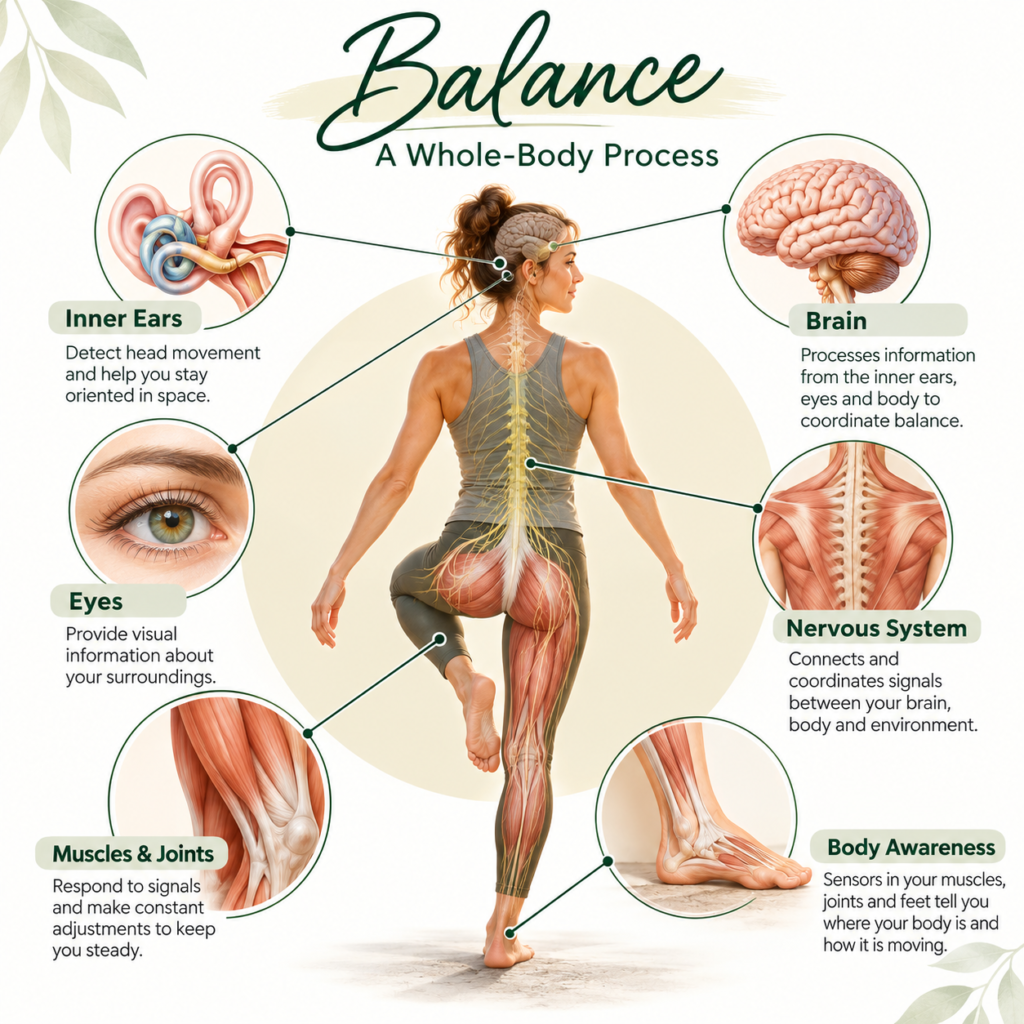
Our eyes provide information about our surroundings and help us understand where we are in relation to the environment.
The vestibular system in the inner ear detects movement and changes in head position. It also provides the brain with information about our relationship to gravity.
At the same time, sensory information from our muscles, joints and other tissues helps the brain understand where different parts of the body are positioned. This body awareness is called proprioception.
The brain brings these signals together and coordinates the muscular responses needed to maintain posture and stability.
Think about walking across a smooth floor and then stepping onto grass, gravel or an uneven trail. The surface has changed, and your body immediately begins adjusting.
Your eyes take in information about the ground ahead. Your inner ears detect movement, while sensory information from your feet, ankles and other areas helps your brain understand what is happening beneath you.
The brain processes these signals and coordinates the necessary adjustments. When information from one source becomes less useful, the nervous system can rely more heavily on other available information.
This is why balance is not one isolated function. It involves the continuous cooperation of our sensory systems, brain, nervous system and muscles.
Why Balance Matters at Every Age
Balance is often discussed in connection with aging and fall prevention. That is important, but we should not wait until balance becomes difficult before paying attention to it.
Good balance contributes to coordination, stability and confident movement throughout life.
It helps us respond when something unexpected happens. We might step awkwardly off a curb, trip over something in the yard or lose our footing on a slippery surface. The ability to recognize the change and respond quickly can help us recover our footing.
Strength plays an important role here too. The nervous system can recognize that the body is moving out of position, but the muscles still need to respond.
This is why balance, strength, mobility and coordination work together rather than functioning as completely separate parts of fitness.
Maintaining these abilities throughout life helps us continue doing the activities we enjoy, whether that means hiking, gardening, dancing, playing with grandchildren or simply moving confidently through everyday life.
Training Your Body to Stay Steady
Just as we challenge our muscles to maintain strength, we can challenge the systems involved in balance.
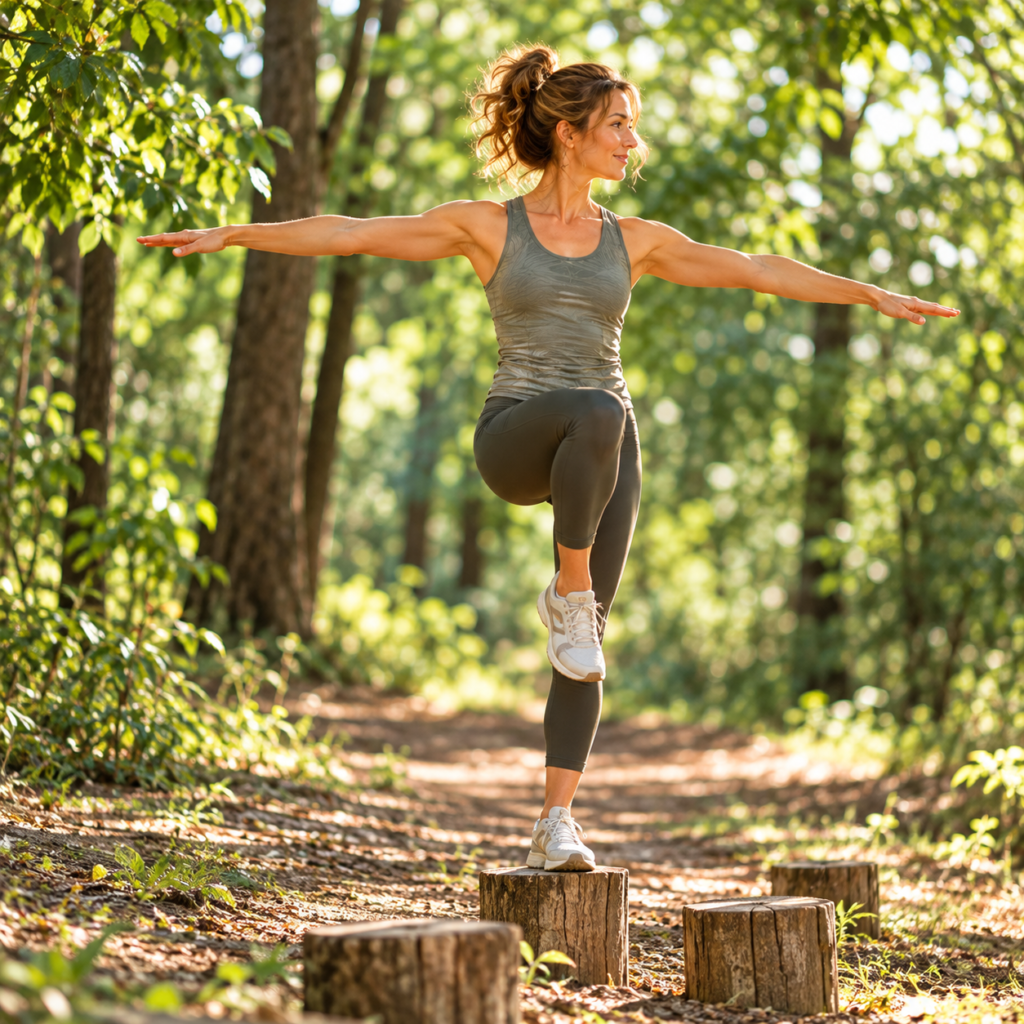
The exercises do not need to be complicated. Standing on one leg, walking heel-to-toe or changing the position of our feet can make the body work differently to remain steady. Tai chi and some forms of yoga also incorporate balance alongside strength, mobility and body awareness.
The important word is challenge.
If an exercise requires no adjustment at all, it is not asking very much from the balance system. As balance improves, the challenge can gradually change. That might mean holding a position longer, changing the position of the arms or introducing gentle movement.
Balance training does not always need its own workout, either. You can practice while waiting for the coffee to brew, standing at the kitchen counter or brushing your teeth. Try standing on one leg for a short period, then switch sides.
Regular activities can challenge balance too. Walking on natural surfaces, gardening, hiking and dancing all require the body to respond to changes in position and environment.
Safety matters. Exercises should match your current ability, with a sturdy countertop or other stable support nearby when needed.
The goal is not to perform a perfect one-legged pose. It is to keep giving the body opportunities to sense, respond and adjust.
The Nervous System Connection
Physical balance gives us a good example of how much the nervous system does behind the scenes. But maintaining stability is only one of its many responsibilities.
The nervous system is involved in movement, breathing, digestion, sleep, heart rate, stress responses and countless other processes throughout the body. Supporting nervous-system health is therefore about much more than feeling calmer. It is part of caring for the body as a whole.
Stress does not switch our balance system off. However, our nervous-system state can influence attention, muscle tension, breathing and how we respond to our surroundings.
This is one reason I consider nervous-system support an important part of the bigger picture when working with clients.
One of the tools I use in my practice is personalized sound files, created from an individual’s voice frequencies. I use them as a relaxation and nervous-system support practice that can become part of a daily routine.
These sound files are not a treatment for balance problems, and research has not established that personalized voice-frequency files improve physical balance or nerve signaling. They do not replace balance training, movement or appropriate medical care. Instead, they are one of the ways I incorporate relaxation practices into a broader approach to wellness.
Looking at the Bigger Picture
Balance reminds us that the systems of the body rarely work independently.
Our eyes, inner ears, sensory receptors, brain and muscles must communicate and coordinate for us to move confidently through the world. Strength, mobility and regular movement all contribute to this process.
By including balance exercises alongside cardiovascular activity, strength training and flexibility, we give the body more opportunities to maintain these important abilities.
We do not need to wait until balance becomes a problem to work on it. A few minutes incorporated into everyday life can be a good place to start.
More importantly, understanding balance gives us a glimpse into something much bigger: the constant communication and coordination taking place inside the body every second of the day.
It is another reason I believe in looking at the whole person — body, mind & soul — and connecting the dots.
If you experience new or persistent dizziness, vertigo, unexplained loss of balance or repeated falls, talk with your healthcare provider. Balance problems can have many causes and sometimes require medical evaluation.